Wall Text
Looking the Rat in the Mouth
On Arslohgo's “Rat Stink”
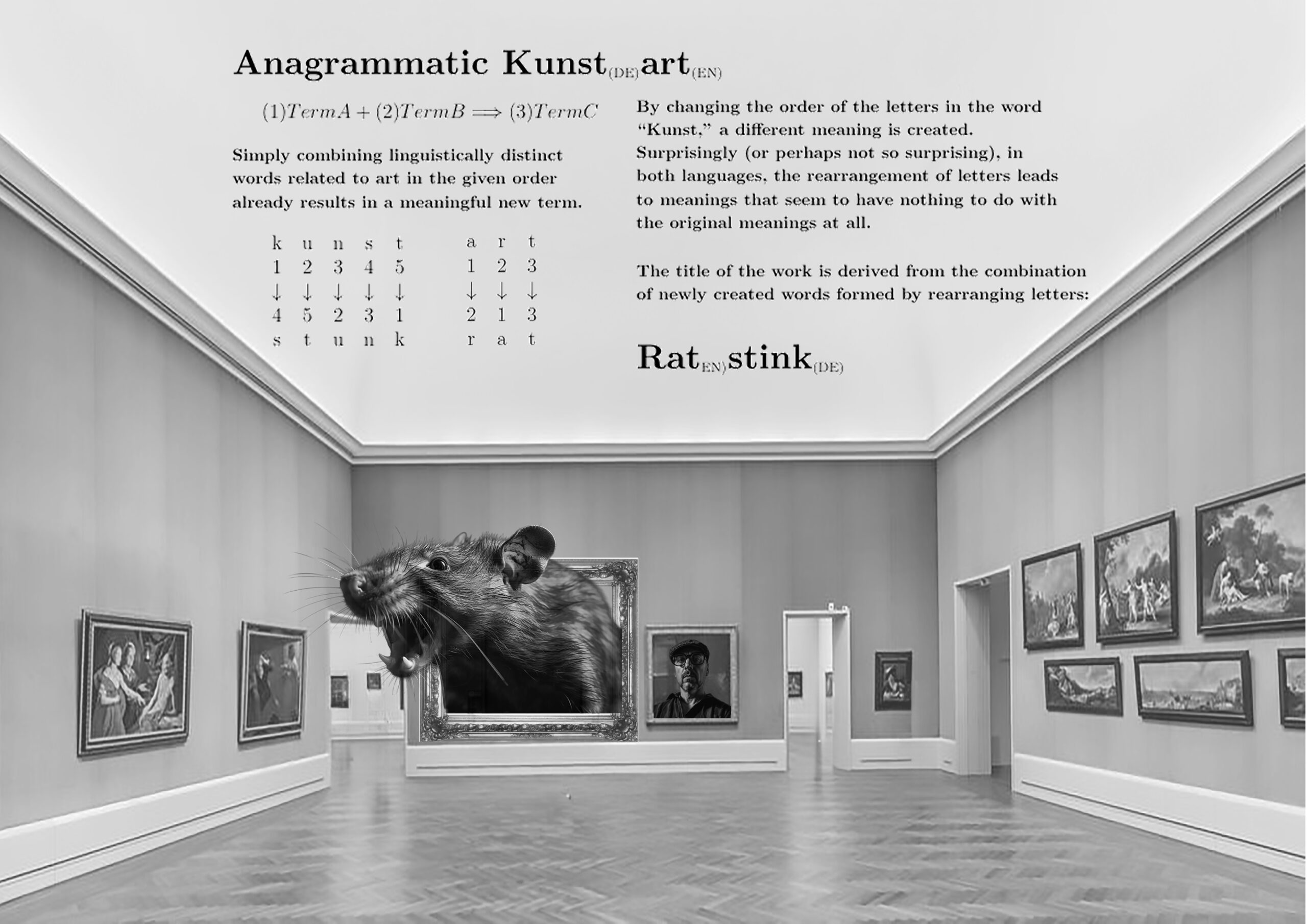
It begins, as every good provocation does, with a bit of arithmetic. Take the German Kunst and the English art, set these two words for the same exalted thing side by side, and before a single brushstroke the plain sum already yields sense: Kunstart, the genre, the category. So much for the well-behaved reading. But Arslohgo isn't content with the obvious. He reaches into the letters like a pickpocket into someone else's wallet and reshuffles them: Kunst becomes stunk, art becomes rat. And there it is—the title of the work, hanging finished on the wall: Rat Stink. This German-English hybrid, half vermin (rat, EN), half rumpus (Stunk, DE), is nothing other than art itself, given one good shake.
That's the whole joke, and it's a wicked one: the letters of the sublime were always ready to regroup into a stench. In both languages. The anagrammatist proves no thesis; he merely exposes what was dozing in the material all along. Art contains the rat the way a museum contains moths—you need only shuffle the letters into the right disorder.
And Arslohgo shuffles them monumentally. The staging relocates the verbal gag into the holiest of rooms: the classical museum gallery, its parquet gleaming, steeped in reverent gray, its walls hung close with Old Masters in gilded frames. The temple of Kunst. And bursting into the middle of it—three-dimensional, hissing, incisors bared—the rat erupts from its frame. Not in the picture but out of it, splitting the ornamental gold, as though the animal hidden in the word had resolved at last to become flesh. What the typography up top drily asserts, the image below carries out as an ambush. The rat leaves the art. Institutional critique needs no footnote here: the vermin was always inside—inside the gilded frames, inside the trade, inside the word.
Both touching and sly is the small self-portrait beside it—the artist, bespectacled, capped, in modest black and white, neatly framed and neatly small. He hangs there like a second-rank Old Master while his own creature mercilessly steals the show. A picture of the maker outgrown by his creation; the rat-keeper shrinking to a footnote beside the rat-stink. Read it, if you like, as the whole humility gesture of conceptual art: the author steps back, the procedure takes over.
Nor should one miss the signature. Arslohgo—the Latin ars (art, craft) soldered to the brand logo, with a Lohmann-ish overtone and that unmistakable scatological echo that grounds the whole affair. The artist's name is itself an anagram joke in miniature: art as trademark, as label, respellable at will until the refined ars smells like something else entirely.
Where criticism is due, let it be delivered: the pun carries exactly as far as it carries—and not an inch further. The punchline lands full-force on the first reading and is already cracked on the second; an anagram has no second secret. The visual language, too—rat bursts gilded frame—is more an illustration of the title than a statement in its own right; the work shows what it says, and risks exhausting itself in its own cleverness. The stink it intends stays calculated, a mini-scandal with a wink rather than a real stench.
But perhaps that is precisely the finest twist. For what is the art world if not a machine that reliably turns Kunst into stink—the sublime into the talking point, the work into the headline, the genius into the rat in the frame? Arslohgo hasn't commented on this mechanism. He has spelled it out.